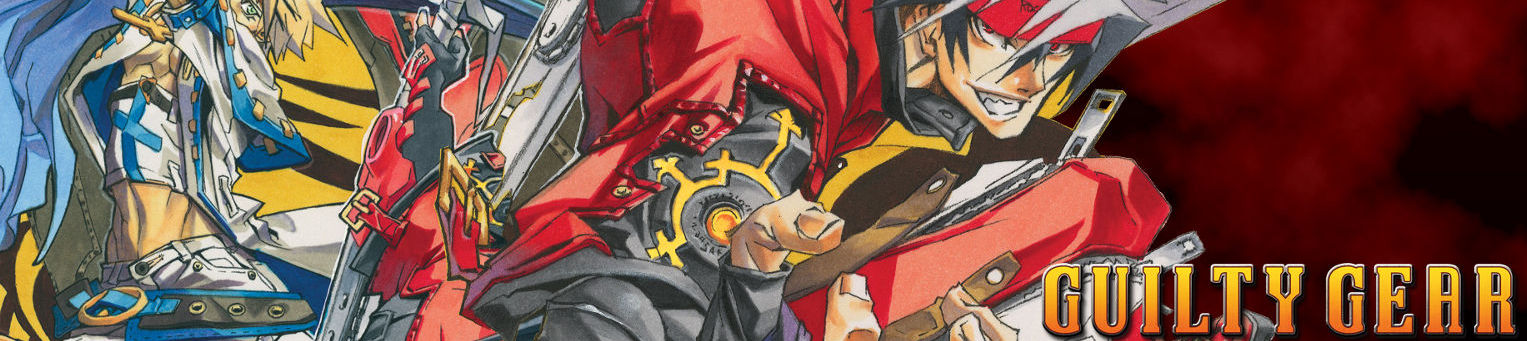
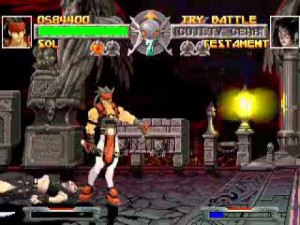
 Guilty Gear is a fighting-game franchise with roughly 17 entries to its name, depending on how spin-offs and re-releases are counted. Aside from a four-year gap between 2008 and 2012, the series has produced a new Guilty Gear game in some form almost every year since 1998 — making it one of the longer-running franchises in the genre, even though the original game gave little indication it would spawn a series at all. Fighting games were common in the late 1990s, with Capcom dominating the market through “Marvel Vs. Capcom,” “Rival Schools,” and “Street Fighter,” then in its “Alpha 3” iteration. Daisuke Ishiwatari and his studio, Arc System Works, took a different approach. At the time, most fighting games leaned toward one of two visual styles: Japanese developers followed Capcom’s cartoony-but-grounded “Street Fighter” look, while Western developers followed “Mortal Kombat”‘s hyper-realistic, gorier aesthetic. Ishiwatari combined both styles with a heavy dose of shonen-manga influence. The result was Guilty Gear: The Missing Link.
Following Capcom’s approach, each of the game’s ten playable fighters was styled after anime and manga archetypes — cartoony but weighty, each with a distinct feel. Unlike Capcom’s cast, however, many of Guilty Gear’s fighters wielded sharp weapons without hesitation. The overall look drew heavily from manga and anime of the era, with a resemblance to titles like “Ghost in the Shell,” “Ninja Scroll,” and “Berserk” that is easy to spot on comparison. The story followed a similarly over-the-top register — mostly a pretext for the fighting, though presented with some ambition. In brief: in the early 2000s, humanity created artificial servants known as Gears to handle labor, until the Gears rebelled and fought their creators. The war ended with the Gears’ leader, Justice, imprisoned within a multi-dimensional prison. A surviving Gear, Testament, later sets out to free Justice, prompting a tournament to find the strongest fighter capable of stopping them.
The original Missing Link was followed in 2000 by Guilty Gear X, which introduced the Roman Cancel system — a mechanic that lets a player cancel out of an attack’s recovery frames at the cost of meter, opening up combo routes the original game didn’t support. X’s home-console follow-up, Guilty Gear XX, became the series’ longest-lived single entry: rather than a conventional numbered sequel, Arc System Works released a run of balance-focused revisions — #Reload, Slash, Accent Core, and finally Accent Core Plus R — that kept the same roster and stage set current in arcades and on home consoles for the better part of a decade. That extended competitive lifespan is a large part of why XX Accent Core Plus R is still the version longtime players return to today.
Guilty Gear’s history also includes several releases that step outside the traditional one-on-one fighting format. Guilty Gear Isuka, released in 2003, supported four fighters on screen at once rather than the series’ usual two, an experiment not repeated in later mainline entries. Guilty Gear 2: Overture, which followed in 2007, went further still, replacing the fighting-game structure with real-time strategy and action-adventure elements — the most significant departure from the core format in the series’ history. These detours sit alongside the handheld spin-offs Dust Strikers and Judgment as evidence that Arc System Works has periodically tested formats beyond the core 2D fighter, even as the numbered mainline entries kept close to their original design.
The series’ visual identity changed again with Guilty Gear Xrd, which replaced the hand-drawn 2D sprites used in every earlier entry with 3D character models rendered to look hand-drawn — a cel-shading technique that preserved the same exaggerated, manga-influenced motion as the older sprite work while running on then-current console hardware. Guilty Gear -Strive-, released in 2021, carried that visual approach forward and paired it with a simplified input system and rollback netcode, factors widely credited with giving Strive the largest and most consistently active online population the series has had. For a broader look at how each entry fits together, see this site’s overview of every mainline and spin-off Guilty Gear release.